Heat stress and UK food imports from the Mediterranean
Mediterranean region has seen heat stress amongst agricultural workers increase markedly in recent decades.
Last updated:

On top of climate change driven heatwaves, a particularly strong El Niño effect – which the UK Met Office have warned could be the strongest since the 19th century – will amplify climate change impacts. One of the growing threats from these rising temperatures is heat stress. Research is highlighting the role of not just temperature, but also of humidity.
Agricultural workers worst impacted
The International Labour Organisation calculated, in 2019, that, by 2030, heat stress would cut working hours globally by 2.2%, costing $2.4 trillion in GDP – a rise from $280 billion in 1995. More recently, in 2024, the ILO estimated that 71% of the global workforce is exposed to excessive heat, with that proportion rising to 74.7% in Asia, 83.6% in the Arab states, and 92.9% in Africa.
Studies presented in the 2025 report of the Lancet Countdown on health and climate change have looked at the growing impacts from heat stress, around the world, including on workers and productivity. Those working outdoors are worst affected, unable to take advantage of building cooling methods, and often with limited shade in increasingly extreme levels of heat.
Freyberg et al (Ruby Coast Research Centre) looked at the working hours lost to heat stress over time in countries around the world. In 2024, around 1.5 billion people worldwide – a quarter (25.3%) of the working-age population – worked outdoors.
Agricultural workers are by far the group most exposed to heat stress. Globally, according to Freyberg et al, they account for nearly two-thirds (63.5%) of all potential work hours lost.
This rises to exactly two thirds in medium Human Development Index (HDI) countries, and three quarters (75.5%) in low HDI countries. This compares to construction workers, who account for 17.7%, service workers (10%), and manufacturing workers (8.8%).
A growing risk to UK food security
The Mediterranean is one of the world's most climate-vulnerable regions and, increasingly, one where agricultural workers are being exposed to rising levels of dangerous heat. It is also a critically important source of food for the UK. In 2025, the 22 Mediterranean countries included in this analysis supplied around £18.1 billion worth of food imports, accounting for a quarter of UK food imports (26.8% of the UK's food import value and 25.1% of import volumes by weight).
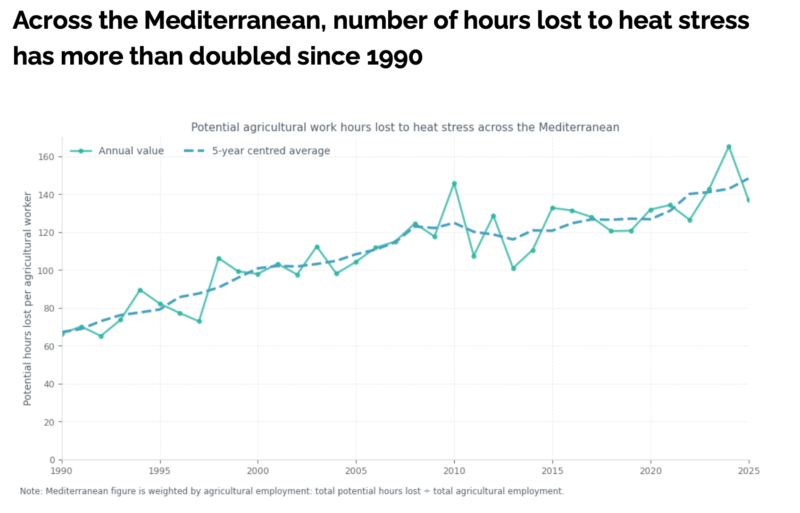
Looking across the region, heat stress among agricultural workers has increased markedly over recent decades. In 2025, agricultural workers across these Mediterranean countries lost an estimated 2.8 billion potential working hours to heat stress. Across a workforce of around 20.5 million agricultural workers, that equates to almost 137 hours lost per worker.
In 1990, the equivalent figure was just over 66 hours per worker, meaning heat-related work losses have more than doubled over the past 35 years. The long-term trend is clear and statistically significant, with hours lost per worker rising by around two hours per year on average since 1990.
Rising risks across the region
Recent years have seen some exceptionally high levels of heat stress. The regional average reached a record annual level of 165 hours lost per worker in 2024 before falling back to 137 hours in 2025. However, even after this decline, the underlying trend continued to rise, reaching its highest level on record in 2025. This illustrates how individual years can fluctuate around a steadily increasing baseline as climate change raises the overall risk of dangerous heat exposure
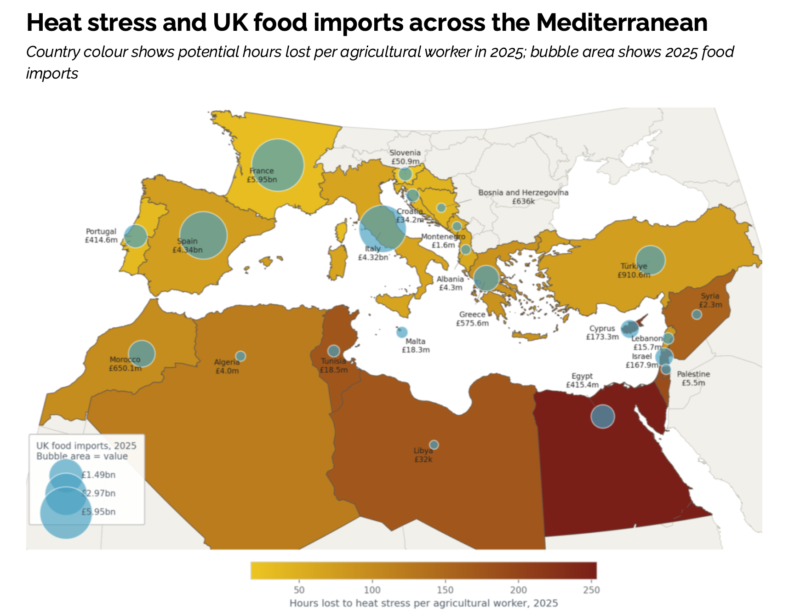
In some countries, the absolute levels of heat stress are already extremely high. Agricultural workers in Egypt lost an estimated 254 potential working hours, per worker, to heat stress in 2025, while the equivalent in Cyprus, Israel, Palestine, Tunisia and Libya was around 170-220 hours. Even in major European food supplying countries where absolute levels are lower, the trend remains upwards. Spanish agricultural workers each lost an estimated 73 hours in 2025, compared with 56 hours a decade earlier, while Greece rose from 67 to 89 hours over the same period. As temperatures continue to rise, these losses represent a growing constraint on the ability of workers to safely carry out already hard and physically demanding outdoor jobs.

Fruits and vegetables
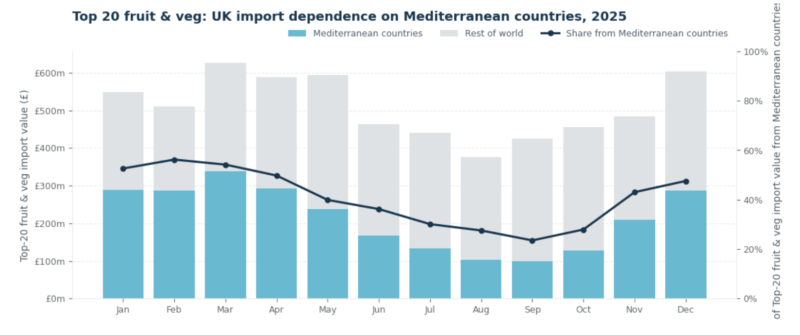
The UK imports around 40% of the food we consume, including 86% of its fruit and 44% of its vegetables (Defra, 2025). Our analysis indicates that 42% of the top 20 most purchased fruit and vegetables, came from Mediterranean countries in 2025 and our import-dependence peaked in February and March. There’s considerable seasonal variation depending on the seasonality of production of these products in the UK, the Mediterranean, and the rest of the world.
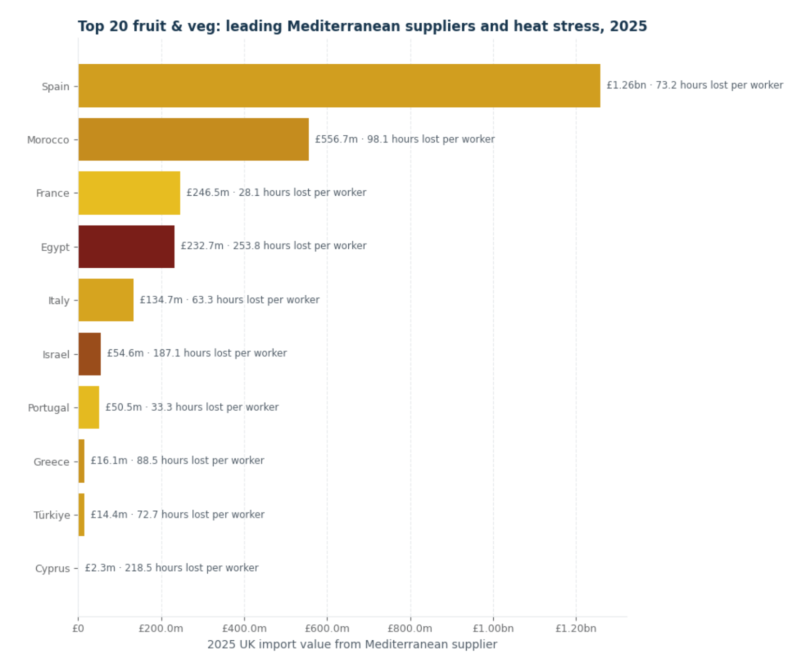
Spain dominates Mediterranean supply among these products, accounting for around half of the import value, followed by Morocco and France. Together, the three largest suppliers account for just over 80% of Mediterranean imports to the UK.
Exposure to heat stress also varies considerably between suppliers: estimated potential hours lost per agricultural worker range from 28 in France to 254 in Egypt, with Morocco at 98 hours and Spain at 73. Across all Mediterranean countries that supply these fruit and vegetables, an estimated 92 potential hours are lost per worker each year to heat stress on average.
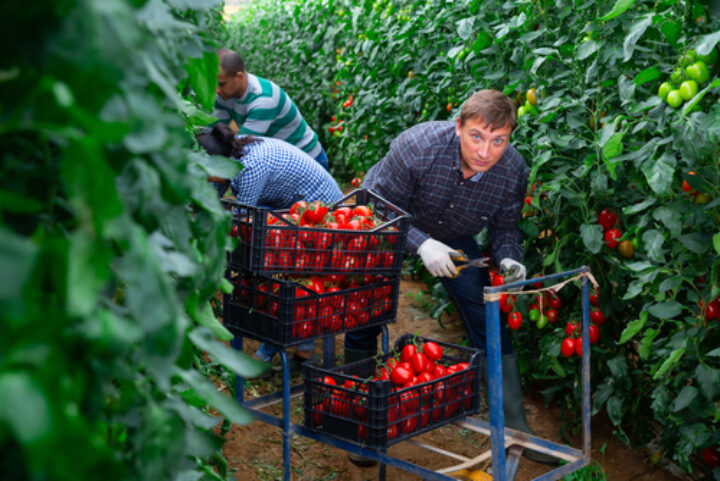
This exposure should not be interpreted uniformly across crops or production systems. For example, in southern Spain, particularly around Almería, a significant share of vegetables such as tomatoes, peppers and cucumbers is grown under plastic. Although protected cultivation can reduce the exposure of crops to some external conditions, it does not necessarily reduce heat exposure for agricultural workers. Studies of Almería-type plastic greenhouses have found substantial occupational heat-stress risks, with poorly ventilated structures capable of becoming considerably hotter than outdoor conditions (Callejon-Ferre et al, 2011). National heat-stress estimates presented here should therefore be interpreted as measures of ambient climatic exposure and may not capture additional heat experienced by workers inside protected horticultural systems such as this.