The UK's scrap gap
Assessing the options for forging the UK steel industry’s future
Last updated:
The UK steel industry is in the middle of a transition that is both unavoidable and, if managed well, an opportunity. The evidence presented in this report points to a sector that retains genuine economic weight, sits at the heart of strategically important supply chains, and stands at the threshold of a technology shift whose economic consequences will be shaped by the investment, regulatory, and procurement decisions taken over the next several years.
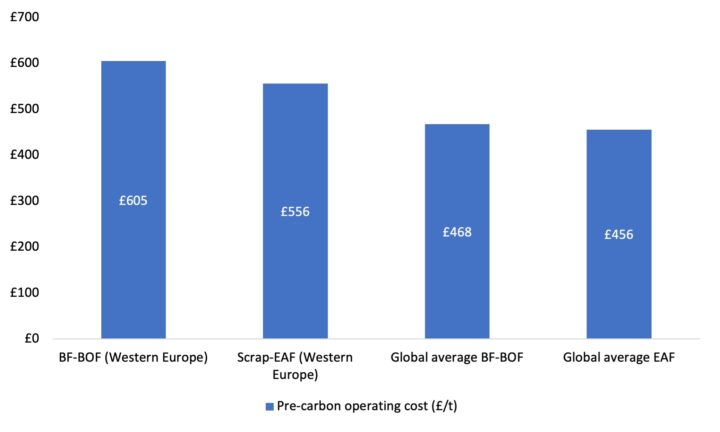
The economic evidence points in a consistent direction. Even before carbon pricing, Western Europe cost data suggests scrap-based Electric Arc Furnace (EAF) production compares favourably to blast furnace steelmaking: it is faster and cheaper to build, and it is well-placed to benefit from the UK’s grid decarbonisation trajectory as renewable capacity expands. The grade capability gap that once constrained EAF’s market has narrowed substantially and is not an obstacle to transition for the large majority of products. The UK’s domestic scrap surplus, currently largely exported, represents a feedstock resource that the EAF transition creates the conditions to retain.
Production cost by technology type (£ per tonne)
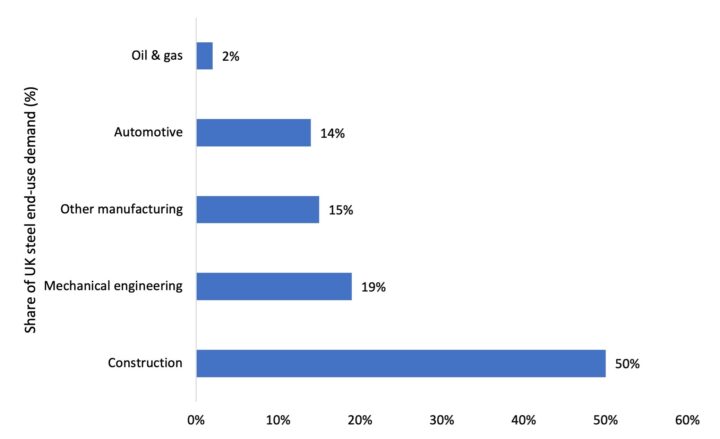
The demand outlook is relevant context for assessing the scale of the capacity gap. UK steel consumption is projected to grow 54% by 2050, driven by construction, offshore wind, transmission infrastructure, and automotive. The expected domestic production pipeline falls 7.3 Mt short of that demand, representing a cumulative market opportunity of around £93 billion between now and 2050 that will be met by imports unless domestic capacity is built. Analysis estimates that closing that gap, in its entirety, would require over two Port Talbots’ worth of new EAF capacity, making the scale and timing of the required investment concrete.
UK steel demand by end-use sector, 2025
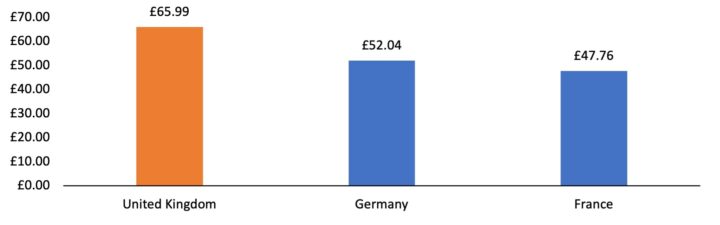
The analysis also identifies the conditions under which that investment case holds. A residual electricity cost disadvantage of approximately £6.10 per tonne relative to German competitors and £7.90 per tonne relative to French competitors remained in 2025/26, driven by higher network charges and wholesale electricity costs. The April 2026 increase in Network Charging Compensation will have eased this, leaving the remaining gap concentrated in wholesale costs. To the extent that wholesale costs fall as the clean power transition progresses, the electricity cost disadvantage narrows.
Electricity price for steel producers 2025/26 (£/MWh, including all exemptions and compensations)
The direction of travel is broadly clear. Whether it leads to a competitive, well-capitalised domestic steel sector or to a narrower, more import-dependent one will be shaped by how the investment, regulatory, and procurement conditions identified in this report develop over the next several years. The analysis suggests the economic foundations for a positive outcome are present. The degree to which they are realised remains an open question.