Revealed: Food inflation driven by climate impacted foods – not wages or regulation
A group of five everyday staples is responsible for much of the UK’s food inflation, with climate change rather than government policy the key driver of rising grocery bills.

By Christian Jaccarini
info@eciu.netShare
Last updated:
Foods hit by extreme weather are rising over two times faster than the rest of the food basket, according to new analysis by the Energy & Climate Intelligence Unit (ECIU) [1].
The ECIU finds that although these items make up just 11% of the average shopping basket, they have accounted for 30-40% of all food price inflation for much of the past two years.
The acceleration and deceleration of inflation in these products has been the story of food inflation in recent times. As the chart below indicates, if it wasn't for this small group, food inflation would have been broadly in line with the Bank of England's 2% target.
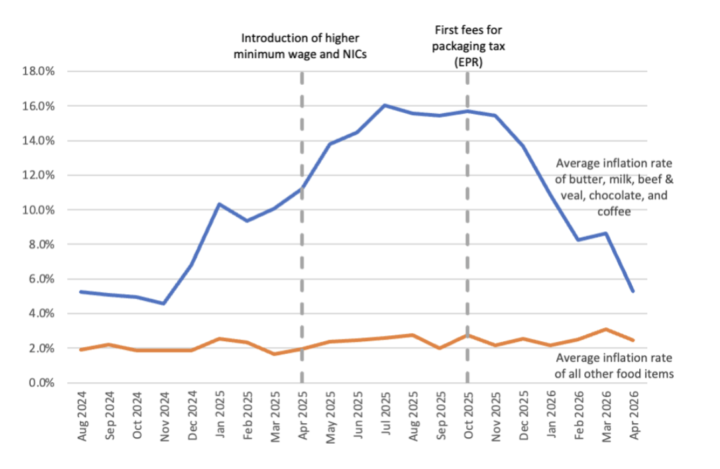
Inflation for these five foods - butter, beef, milk, coffee and chocolate - peaked at 16.0% in July 2025, over six times higher than the 2.6% average inflation rate for all other food and drink. Food inflation is a key contributor to the UK’s headline inflation rate, with the Bank of England warning that extreme weather is increasingly influencing prices [2].
The findings come as households are braced for the impact of the Iran war on food prices, with food prices on track to be 50% higher by November 2026 compared to levels at the start of the cost-of-living crisis in mid-2021 [3]. Food inflation ticked down in April, with the war’s impact yet to feed through to consumer prices.
Chris Jaccarini, land, food and farming analyst at the Energy and Climate Intelligence Unit (ECIU) said:
“While today’s inflation figures suggest that conflict in the middle east has not yet fed through to food prices, pressure is building in supply chains. Food prices are on track to be 50% higher than when the cost‑of‑living crisis began in mid‑2021, while energy, insurance and water have already reached that milestone [3].
“While wage bills and regulation play a role, they don’t explain why coffee, chocolate or milk prices have surged. Climate shocks do – and until we stabilise the climate, households will keep paying the price. We have now seen three of the five worst harvests on record this decade due to extreme weather [4], and scientists are predicting 2027 to be the hottest year on record with climate change combining with the El Nino effect kicking off this year.
“Unless we break the link with fossil fuels and bring emissions to net zero, these pressures will intensify. Only net zero can bring the climate back into balance and protect us from whims of Putin and Trump."
It is not just British-grown foods that are at risk. The UK imports around 40% [5] of its food from overseas, including many staples like rice, bananas and tea, which we cannot simply grow at home.
In 2022–23, climate impacts added an estimated £360 to the average UK household food bill [6]. Government forecasts suggest household climate exposure will deepen, with over half of UK fruit and legume imports coming from climate-vulnerable countries by 2050.
Central banks are clear that climate change increases food prices in ways they cannot control or predict, creating systemic risk to our food system [2].
Notes to editors:
1. This is an update to previous work. For more background detail see https://eciu.net/media/press-releases/why-food-prices-are-still-rising-butter-beef-and-milk-to-blame
2. August Bank of England Monetary Policy Committee Report and recent interview with Interview with Isabel Schnabel, Member of the Executive Board of the ECB
3. ECIU (2026) Food prices set to rise by 50% since start of cost-of-living crisis, new analysis shows https://eciu.net/media/press-releases/food-prices-set-to-rise-by-50-since-start-of-cost-of-living-crisis-new-analysis-shows
4. ECIU (2025): UK on course for fifth worst harvest after drought hits staple crops – new data https://eciu.net/media/press-releases/2025/uk-on-course-for-fifth-worst-harvest-after-drought-hits-staple-crops-new-data
5. Government -produced UK Food Security Report 2024.
6. ECIU, Families hit by £605 food bill as extreme weather and energy crisis bites (2023): https://eciu.net/media/press-releases/2023/families-hit-by-605-food-bill-as-extreme-weather-and-energy-crisis-bites
For more information or for interview requests:
George Smeeton, Head of Communications, ECIU, t: 020 8156 5305, m: 07894 571 153, email: george.smeeton@eciu.net