New analysis finds widespread misinformation around EVs in UK newspapers
Quarter of all the articles on electric vehicles (EVs) analysed contained at least one misleading statement about electric cars.
By Tricia Curmi
info@eciu.netShare
Last updated:
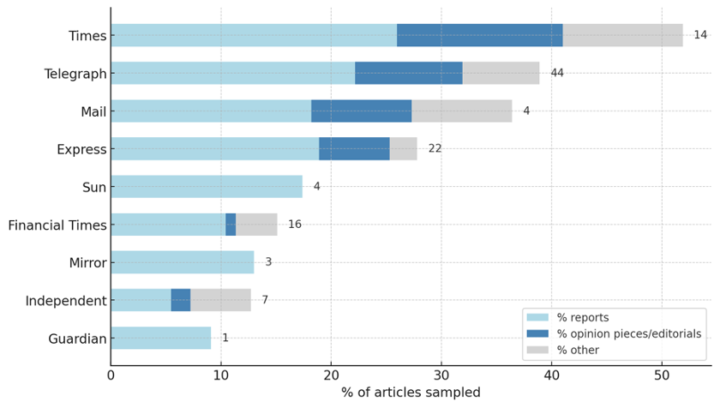
New analysis [1] of articles on electric cars in UK national newspapers has found widespread misinformation. Just over a year on from a House of Lords report that identified misinformation as one of the main barriers holding back the UK’s EV transition, new analysis of six months of articles found that 25% of all EV-relevant articles analysed contained at least one misleading statement about electric cars.
The misleading statements made about EVs covered a range of topics including:
- the notion that demand for EVs has been stalling or falling in the UK, when in fact overall sales of electric cars have been increasing over the past few years
- that EVs are more expensive without referencing evidence that their lifetime ownership costs are often hundreds, even thousands, of pounds cheaper a year
- the implication that EVs are a fire hazard by failing to provide the context of evidence showing that EVs are up to 80 times less likely to catch fire than petrol cars.
The author of the report, Simon Cocks, a researcher at the University of Oxford, said: “Much of the misinformation found in these articles is what is known as ‘paltering’, cherry picking anecdotes, statistics or other source material to create an inaccurate impression about some aspect of electric vehicles.”
“While an anecdote, like someone claiming their EV ran out of battery, may be true, using it to make a more general claim that all EVs have very limited ranges and are not suitable for long trips is not supported by the broader evidence and can be misleading for the reader.”
Commenting on the analysis Colin Walker, Head of Transport at the Energy & Climate Intelligence Unit, said: “It’s important that the driving public are getting a factual and balanced view of electric vehicles. The disconnect between many articles and the experience of actual EV drivers, the vast majority of whom report a positive experience, is stark. [2]
“Polling suggests the more misinformation you believe, the less likely you are to buy an EV, meaning readers might be put off when they could be saving hundreds of pounds a year on their driving bill given the cheaper charging and lifetime costs of an electric car.
“You’ve had this strange situation with many newspapers suggesting demand is falling when sales are up. They often go on to claim this means the Government’s EV sales targets won’t be met, ignoring the flexibilities that were built-in to those targets to make them easier for the industry to hit. But they’ll then report that the car industry has been successful in lobbying for more of these flexibilities so it can hit its targets. Do flexibilities count or not?
“The global shift to EVs is clearly now unstoppable and so the future of the UK’s car industry, which exports 80% of its output, can only be secured if it is able to make a rapid and successful transition to building electric cars as petrol and diesel sales fall. Spreading misinformation will only serve to suppress domestic demand for these vehicles, undermining our car industry and the people who work in it”.
Percentage of articles from each media outlet containing a misleading statement
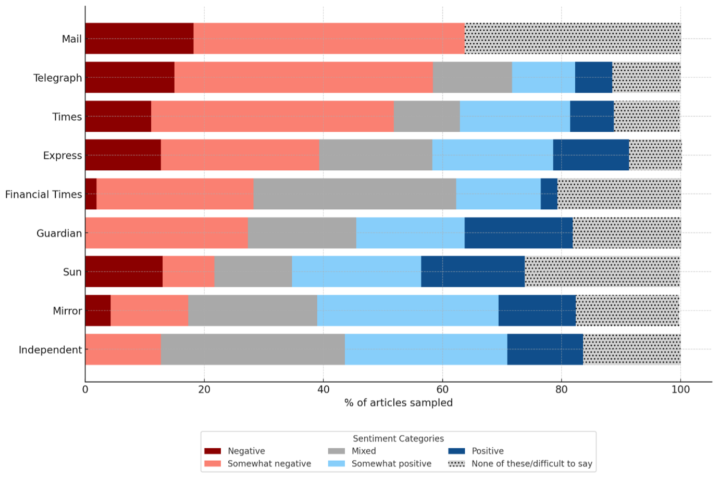
More than a third (38%) of the articles sampled framed EVs in a negative light, while a quarter (26%) framed them in a positive light. Surveys of EV drivers have found that around 90% of EV drivers would not go back to driving a petrol or diesel.
Percentage of articles from each media outlet in each sentiment category
Polling of petrol car drivers by YouGov for the Energy and Climate Intelligence Unit (ECIU) found a ‘poor’ level of knowledge of electric cars, illustrating the impact of EV misinformation. When asked if ten separate statements about EVs were true or false, more than half (57%) of petrol/diesel cars drivers got just two or less out of ten correct, with 90% scoring just five or less out of ten. Around a quarter (23%) got none correct. This is affecting drivers’ car choices, with people displaying a poor understanding of EVs being less likely to want their next car to be an EV. Drivers who scored two or less out of ten were 11 times less likely to want their next car to be an EV than those who scored eight or more out of ten [3].
A report by CBI Economics for the ECIU revealed that a failure by the car industry to make the transition to manufacturing EVs could see its contributions to the UK economy fall by as much as 73%, or £34.1bn, and over 400,000 jobs could be lost. Conversely, economic output could increase by over £16bn, and 167,000 new jobs could be created, if a rapid and successful transition takes place. [3] Government support is critical in avoiding such an outcome, and this includes the provision of a stable and supportive regulatory environment through keeping measures like the ZEV Mandate in place.
Notes to editors
[1] Full report can be found here: EV Media Report
[2] https://www.evaengland.org.uk/2025/06/20/electric-and-loving-it-why-ev-drivers-wouldnt-go-back/
[4] https://www.cbi.org.uk/media/qoxp3pn4/cbi-economics-eciu-ev-sector-report-2024.pdf
For more information or for interview requests:
Colin Walker, Head of Transport, ECIU, Tel: 07779 284912, email: colin.walker@eciu.net