The Christmas Chocolate Climate Crunch
New analysis finds Christmas chocolate prices nearly double and tub sizes shrink as climate shocks hit cocoa, sugar and dairy.

By Christian Jaccarini
info@eciu.netShare
Last updated:
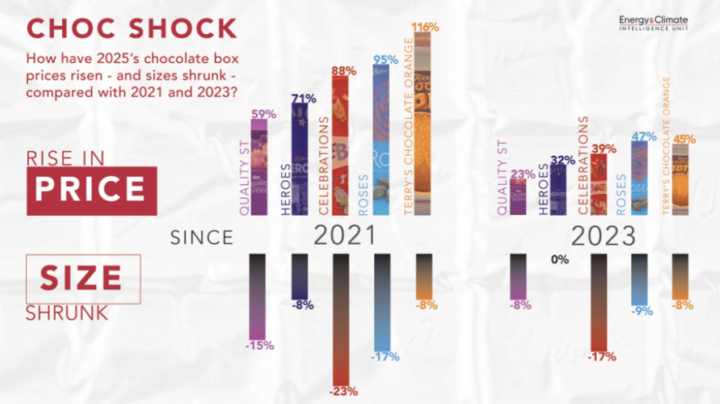
As families across the UK prepare for the festive season, the cost of a holiday staple - those big sharing tubs of chocolates - has risen dramatically according to new analysis from the Energy & Climate Intelligence Unit (ECIU) [1].
Since 2021, the price per 100g of popular chocolate assortments like Quality Street, Celebrations, Roses, and Heroes has surged – in some cases almost doubling. Roses are up 95%, Celebrations 88%, Heroes 71% and Quality Street 59%. Even over just the past two years, prices are up 23–47% across the major brands, compared to general inflation of 6% in the same period.
Sharing tubs meanwhile are getting smaller. Since 2021, the size of a typical tub of Celebrations has fallen by a quarter (-23%), falling from 650g in 2021 to 500g now, as climate-induced price shocks drive ‘shrinkflation’ in the Christmas chocolate aisle.
And Terry’s Chocolate Orange - a Christmas stocking staple - has seen its price per 100g increase by 116% since 2021, while shrinking 8% in size, meaning it’s now less chocolate orange and more chocolate tangerine.
Commenting, Chris Jaccarini, food and farming analyst at the Energy and Climate Intelligence Unit (ECIU) said:
“Climate change is making the family politics of who gets what from the big tub of chocolates that little bit more fraught this year, as boxes shrink and prices climb. From chocolate to sugar to dairy, the ingredients in our festive favourites are being hit by extreme heat, floods and disease outbreaks across the world. With English farmers facing the second-worst harvest on record, while cocoa growers in West Africa struggle with even more extreme weather, it is only by cutting emissions to net zero that we can limit the impact of climate change on food prices.”
“To stop these climate shocks repeatedly driving food bills higher, we need to cut emissions to net zero, support farmers to adapt, and build a more resilient food system where risk is shared fairly through supply chains. That means wealthy nations stepping up with climate finance for producer countries with low climate readiness. Taken together these actions can reduce volatility in our food system and help British retailers keep supplies and prices stable for UK consumers."
The findings come after a series of climate-driven shocks at home and abroad have disrupted supplies of key ingredients like cocoa, sugar and milk. Record rainfall, drought and extreme heat in West Africa have slashed cocoa harvests [2], while climate-linked swings between waterlogged winters and scorching summers have hurt UK sugar beet and dairy production [3]. At the same time, global sugar cane yields have been hit by heatwaves and failed monsoons in major producers such as Brazil and India [4]. Together, these climate impacts are pushing up costs throughout supply chains and feeding directly into higher prices on UK shelves.
Traoré Ousmane, a Fairtrade cocoa farmer from Côte d’Ivoire and founder of the ECAKOOG cooperative, said: “When it comes to the impact of climate change, it is undeniable this year.Unpredictable rainfall and winds also affect our activities… for example, [farmers] who produced 52 bags of cocoa last year only produced 22 this year, which poses considerable problems in terms of loans and production forecasts.Faced with these challenges, our co-operative has undertaken concrete actions, such as [planting] shade trees… to regulate the climate in cocoa plantations.”
Florence Collenette, Senior Technical Manager for Climate at The Fairtrade Foundation, said: “Smallholder food producers in developing countries grow over a third of the world’s food and are on the frontlines of climate adaptation. Yet, their voices are too often missing from the global conversation. Every day, we hear from smallholder farmers and agricultural workers who are already grappling with the harsh realities of climate change. With less to harvest and sell, farmers face shrinking incomes, while volatile market prices make it nearly impossible to plan ahead or invest in their futures.
“Climate change and market instability aren’t going anywhere. If we want to secure the long-term availability of our favourite products including cocoa, coffee and tea - and protect the livelihoods of those who grow them – governments and businesses must step up. This means investing in sustainable supply chains, ensuring smallholder farmers earn a living income, and equipping them with the resources they need to adapt and thrive in a changing climate.”
Cocoa is the primary raw ingredient in chocolate and cocoa prices are highly exposed to climate risk, with almost all cocoa globally (99.9%) grown in low climate readiness countries. Commodity prices are more than double what they were in 2022, having peaked almost 5 times higher than before the price spike. Some of this increase is still to feed through to consumer prices, which have risen 29% in the past two years and 43% over three years.
ECIU’s previous analysis has found that the price of foods hit by extreme weather are rising over four times faster than others in the average shop [5]. These items - butter, beef, milk, coffee and chocolate - make up just 11% of the average shopping basket but accounted for 40% of all food price inflation in September. And recent analysis [6] by the London School of Economics (LSE) has found that higher levels of chocolate and sugar consumption in the UK help explain much of the higher food inflation here compared to in the Eurozone.
Extreme weather impacts on cocoa production have been compounded by climate shocks to other key chocolate ingredients such as sugar and dairy. Sugar prices have surged since late 2023, with commodity prices reaching their highest level in over a decade in early 2024 [7].
50-60% of UK sugar comes from home-grown beet, and the sector has faced a series of weather extremes and pest outbreaks. A record wet winter in 2023–24 [8] delayed planting [9], while the record dry summer that followed, cut yields for some. Warmer winters have also fuelled aphid infestations and disease outbreaks, reducing yields [10].
Tom Clarke, a sugar beet farmer in Cambridgeshire and NFU sugar board member said: “We’ve had everything thrown at us these past two years — gloomy skies and low sugars in 2024, with fields too wet to plant and harvest, then too dry for some crops to grow in spring this year with increased competition from weeds. And warmer winters threaten to make things worse, with pests surviving in far greater numbers and spreading disease across the crop. Between the weather extremes and rising pest pressure, yields are unpredictable and costs are up. Frequently, we are now paid less than it costs to grow a crop and many farmers face having to give up. Farming has just got too risky, for too little reward.
“Food security is a serious business. With climate impacts hitting farmers at home and abroad, we need supply chains to invest much more in making our food and farming system resilient. That means a fairer share of returns for farming to enable us to adapt and be sustainable. We can no longer expect to easily and cheaply import anything tricky or expensive to grow here. No country is immune to global changes in climate. In an unstable world it’s foolish to increase or embed a structural dependence on imports. “
Notes for editors:
1, The analysis is available to download here.
2. ECIU analysis, Climate Impacts on Cocoa: https://eciu.net/analysis/reports/2025/climate-impacts-on-cocoa
3. Warmer winters (Carbon Brief): https://www.fwi.co.uk/arable/sugar-beet/huge-variability-in-first-sugar-beet-yields-across-the-east; Virus Yellows (National Farmers Union): https://www.nfuonline.com/updates-and-information/disease-control-learn-about-virus-yellows/; Variable harvest recorded (Farmers Weekly) https://www.fwi.co.uk/arable/sugar-beet/huge-variability-in-first-sugar-beet-yields-across-the-east
4. Brazil Drought attributed to climate change (World Weather Attribution): https://www.worldweatherattribution.org/climate-change-not-el-nino-main-driver-of-exceptional-drought-in-highly-vulnerable-amazon-river-basin/
India heatwave attributed to climate change (World Weather Attribution):
https://www.worldweatherattribution.org/extreme-humid-heat-in-south-asia-in-april-2023-largely-driven-by-climate-change-detrimental-to-vulnerable-and-disadvantaged-communities/
Weak monsoon rains (Reuters): https://www.reuters.com/world/india/indias-monsoon-rains-hit-five-year-low-due-el-nino-2023-09-30/
Poor Thai production and general commentary (World Economic Forum): https://www.weforum.org/stories/2023/11/global-sugar-prices-el-nino/
5. https://eciu.net/media/press-releases/2025/why-food-prices-are-still-rising-butter-beef-and-milk-to-blame
6. The climate shocks and consumption habits that are driving the UK’s food inflation higher than Europe’s, https://cetex.org/publications/the-climate-and-consumption-habits-that-are-driving-the-uks-food-inflation-higher-than-europes/
7. IMF Commodities data: https://www.imf.org/en/research/commodity-prices
8. https://www.metoffice.gov.uk/research/climate/maps-and-data/about/state-of-climate
9. https://eciu.net/analysis/reports/2024/climate-and-food-home-and-away
10. https://www.nfuonline.com/updates-and-information/disease-control-learn-about-virus-yellows/
For more information or for interview requests:
George Smeeton, Head of Communications, ECIU, Tel: 07894 571 153, email: george.smeeton@eciu.net