Food inflation from Iran war could hit poorer households 50% harder than richest
ECIU analysis shows that the economic aftershocks of the Iran war are likely to widen inequalities.

By Christian Jaccarini
info@eciu.netShare
New analysis from the Energy and Climate Intelligence Unit (ECIU) shows that the economic aftershocks of the Iran war are likely to widen inequalities, with poorer UK households affected more acutely than richer households.
While today’s inflation figures suggest that conflict in the middle east has not yet fed through significantly into food prices – with food inflation ticking up to 3.7% - pressure is building in the supply chain. Industry forecasts indicate that food prices are likely to rise sharply over the coming months. The Food and Drinks Federation forecasts food inflation to be around 10% by the end of the year [1], which ECIU estimates would increase the average household’s monthly food bill by £32.80 [2].
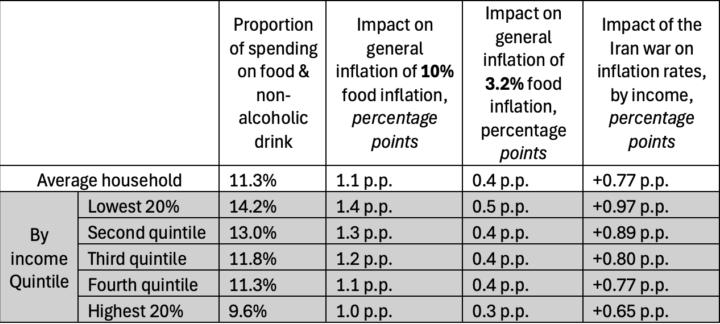
As poorer households spend a larger share of their income on food, rising prices translate into a much bigger effective hit to living standards for those on the lowest incomes. ECIU analysis suggests that for the lowest earning fifth of households, higher food prices alone will push overall inflation around 1.0 percentage point higher than it would otherwise be without the conflict in the middle east. This impact is around 50% higher for the poorest 20% than for the richest fifth of households [3].
The conflict has already driven a sharp increase in key input costs. International fertiliser prices rose by 26% in March alone, while energy prices jumped by 42%, led by a 59% increase in European natural gas and a 46% rise in Brent crude oil [4]. Higher fossil fuel prices feed directly into the cost of energy, transport and packaging, putting upward pressure on food prices.
These cost increases are particularly concerning for the UK’s energy-intensive horticulture sector, which currently relies heavily on gas and electricity to produce fruit and vegetables.
Chris Jaccarini, food and farming analyst at the Energy and Climate Intelligence Unit (ECIU), said: “After years of food prices rising faster than wages [5] households are entering this period with limited resilience. This analysis shows that higher food prices driven by rising oil and gas costs will hit the poorest families hardest, widening existing inequalities.
“What begins as a spike in oil, gas and fertiliser markets can, over six to 12 months, feed through into higher prices at the checkout. That is especially worrying in a food system still heavily exposed to volatile energy markets. Tackling food insecurity therefore has to include building a food system that is less dependent on fossil fuels.
“At the same time, climate shocks are increasingly driving up food prices [6]. With National Security assessments warning that climate change could trigger widespread ecosystem collapse [7], the risks of inaction go far beyond higher grocery bills unless emissions are cut to net zero to bring the climate back into balance.”
ENDS
Notes to editors:
1. Food inflation forecasts are taken from the Food and Drink Federation’s latest and previous outlooks, which project food inflation reaching around 10% by the end of 2026. Source: Food and Drink Federation, FDF revises food inflation forecast to at least 9% by the end of 2026 (2026): https://www.fdf.org.uk/fdf/news-media/press-releases/2026/fdf-revises-food-inflation-forecast-to-at-least-9-by-the-end-of-2026
2. Impact on household food bills
To estimate the impact on household food spending, ECIU first uprated the latest available ONS Family Spending data on food and non‑alcoholic drinks (covering the financial year ending 2024) to account for food price inflation since that period, using the CPI food and non‑alcoholic drinks sub‑index.
ECIU then modelled the additional increase in spending that would result from food prices rising by a further 10% between December 2025 and December 2026, in line with the Food and Drink Federation’s forecast. This results in an estimated £32.80 increase in the average household’s monthly food bill.
Source: ONS, Family spending workbook 2: expenditure by income:
https://www.ons.gov.uk/peoplepopulationandcommunity/personalandhouseholdfinances/expenditure/datasets/familyspendingworkbook2expenditurebyincome
Source: ONS, Consumer price inflation time series: https://www.ons.gov.uk/economy/inflationandpriceindices/datasets/consumerpriceindices
3. Distributional impact, by household income
ECIU used ONS Family Spending data to calculate the share of household expenditure spent on food and non‑alcoholic drinks for the average household and for each income quintile.
A food inflation rate of 10% was then translated into its contribution to headline inflation for each income group, using these spending shares.
To estimate the impact attributable to the Iran conflict, this result was compared with a counterfactual scenario based on the Food and Drink Federation’s previous forecast of 3.2% food inflation. The difference between the two scenarios represents the estimated inflation impact of the conflict by income quintile.
Our modelling does not account for behavioural responses to price changes, such as households changing the types of food they buy as prices rise. It is also too early to determine how higher oil, gas and fertiliser prices will feed through to different food categories. We therefore do not model any variation in these effects across income quintiles.
4. Energy and fertiliser prices. Data on energy and fertiliser prices are taken from the World Bank’s Pink Sheet, which shows that in March fertiliser prices rose by 26%, while energy prices increased by around 42%, driven by sharp rises in European natural gas and Brent crude oil prices.
Source: World Bank, Energy prices surged in March; non‑energy edged up – Pink Sheet (2026): https://blogs.worldbank.org/en/opendata/energy-prices-surged-in-march--non-energy-edged-up-pink-sheet
5. In the 4 years to December 2025, average food prices have risen by 40% while average wages have risen by 30%. Source: Office For National Statistics Consumer Price Index and Average Weekly Earnings.
6. Financial Times: https://www.ft.com/content/66b06e7d-7fa5-4b53-a4c2-55477af59649?syn-25a6b1a6=1; ECB: https://papers.ssrn.com/sol3/papers.cfm?abstract_id=4457821
7. Nature security assessment on global biodiversity loss, ecosystem collapse and national security: https://www.gov.uk/government/publications/nature-security-assessment-on-global-biodiversity-loss-ecosystem-collapse-and-national-security
For more information or for interview requests:
George Smeeton, Head of Communications, ECIU, t: 020 8156 5305, m: 07894 571 153, email: george.smeeton@eciu.net