Mediterranean heat stress: a quarter of UK food imports worth £18 billion at risk, including fruit, veg, olive oil and wine
Extreme heat cost Mediterranean agriculture 2.8 billion potential working hours in 2025, with average losses per worker more than doubling since 1990

By Gareth Redmond-King
info@eciu.netShare
Last updated:
New ECIU analysis [1] of heat stress in Mediterranean nations shows that hours lost to heat stress has risen sharply from an average of 66 hours per worker in 1990, to almost 137 last year (+108%). In 2025, the region’s agricultural workers lost some 2.8 billion potential working hours to heat stress.
Globally, agricultural workers are by far the group most exposed to heat stress, accounting for nearly two-thirds (63.5%) of all potential work hours lost.
With British farmers facing their worst harvest on record this year [4], the UK is becoming increasingly reliant on imported food, which now makes up 40% of all food consumed. Mediterranean countries play a critical role, providing more than half of our most popular fruit and vegetable imports at certain times of the year, as well as many foods like olive oil that we cannot easily produce in the UK.
This analysis comes as August 2026 has just been recorded as the world’s joint hottest month on record. [2] The summer has seen successive heatwaves, over 500,000 hectares of land burned by wildfires [3] and widespread drought. The Western Mediterranean hit new record, high sea surface temperatures, as the Mediterranean, as a whole, heats at twice the rate of global oceans. As these extremes hit food crops, fuelling shortages and driving up food prices, heat stress is a growing problem for people working in agriculture, adding another threat to food security.
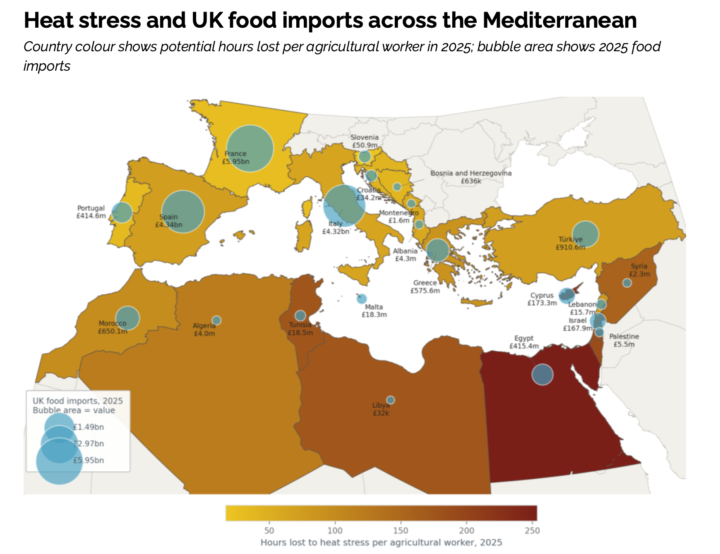
France, Spain and Italy alone account for more than four-fifths (81%) of the value of UK food imports from the Mediterranean. Yet all three countries are seeing rising loses in working hours due to extreme heat, with hours lost increasing by 46% in France and 30% in Spain in the decade to 2015.
Extreme weather is pushing up the cost of food. In 2025, a quarter of our food imports, worth £18.1 billion – a tenth of our overall food supply – came from Mediterranean nations. In that year, we paid 13% more for those imports than three years earlier, in 2022, whilst the volume (by kg) rose by just 1%. Price per kg rose 12%.
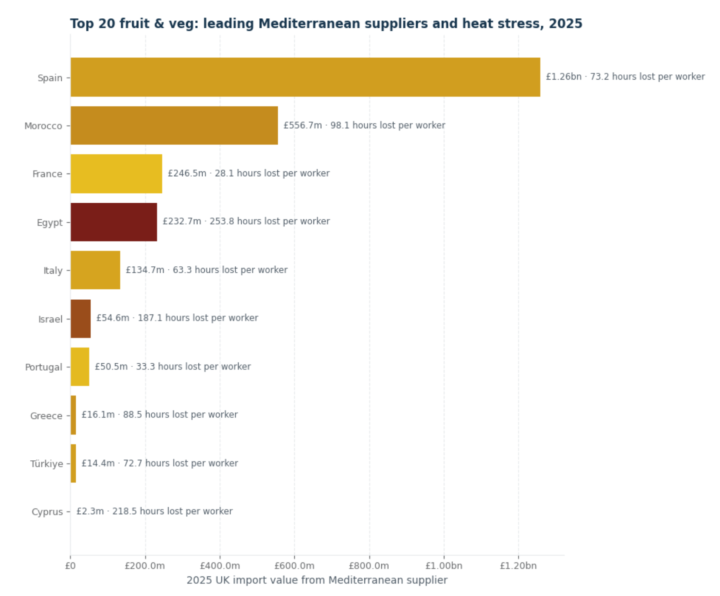
Fresh fruit and vegetables make up 13% and 10% respectively of UK food imports from the region. This includes citrus fruits like oranges, satsumas, and mandarins whose price per kg rose 40% over two years, apples and pears where prices rose by a quarter and 45% respectively over three years, and salad vegetables like sweet peppers, tomatoes, lettuce, and avocados. One of the sharpest price-rises of any product from the region has come in olive oil, where prices more than doubled from January 2021 to late 2024 following extreme heat in the world’s largest producer, Spain. From 2022 to 2024, the price we were paying per kg for our imports of olive oil from the Mediterranean rose 83% from £3.89 to £7.10.
They, and other crop-based products, like wine, are amongst the most climate-sensitive of foods, with highly perishable plants exposed to extreme weather and pest, as well as being heavily reliant on agricultural workers able to work outdoors in increasingly extreme conditions.
Senior economist on food and climate at the Energy and Climate Intelligence Unit, Chris Jaccarini said: “We’ve become used to talking about the impact of climate change on crops, but food production depends on people too. The growing toll which extreme heat is taking on the people working outdoors to plant, tend and harvest our food is becoming increasingly clear. It poses not only a threat to their health and wellbeing but also creates another risk to the food security we all rely on.
"The UK's national security experts have warned that climate change is a growing threat to food security [5], in a report that the government refuses to release in full.Strengthening the resilience of our food system will be increasingly important, but there are limits to adaptation in a rapidly warming world, meaning progress towards net zero is essential to safeguarding food supply."
2026’s brutal European summer has been driven by climate change. But farmers around the world – particularly in continents bordering the Pacific Ocean, now also face a growing threat from what may be the strongest El Niño in living memory [6]. Its impacts have already been felt in the delayed and weakened monsoon rains in India, for example.
Head of International Programme at the Energy and Climate Intelligence Unit (ECIU), Gareth Redmond-King said: “This summer has been a stark and brutal reminder of the growing threats which climate change poses. Extreme heat has claimed over 30,000 lives in Europe this summer [7] as heatwave after heatwave has fuelled fires and drought that destroy people livelihoods and disrupt trade. The growing costs of this have always far outweighed the costs of acting to deliver the only solution we have to halt climate change, which is to cut our emissions from burning coal, oil and gas to net zero. That those costs will become worse in coming months as El Niño throws fuel onto the climate change fire only makes the urgency of acting more clear. As world leaders begin meetings in New York, Fiji and Tuvalu ahead of COP31, it remains to be seen if the scale of their actions can rise to increasingly frightening scale of the threat.”
Notes to editor
- Report available here: https://eciu.net/analysis/reports/heat-stress-and-uk-food-imports-from-the-mediterranean
- August was the world’s joint hottest month on record, pushing global temperatures back above 1.5°C above pre-industrial levels. (Copernicus)
- Record European fires burn over 500,000 hectares over summer (France 24)
- Impact of heatwaves and drought on UK harvest prospects in 2026. (ECIU)
- Nature security assessment on global biodiversity loss, ecosystem collapse and national security. (DEFRA)
- An ‘unprecedented’ El Niño and its implications for the weather forecast. (Met Office)
- Heatwave-hit Europe logs over 30,000 excess summer deaths: first figures. France24)