Most Brits support the electric vehicle transition, polling finds, as apparent Cabinet split emerges over electric vehicles scheme
While DESNZ backs cheaper-to-run EVs amid cost of living crisis, other parts of Government apparently want to slow the switch

By Izzy Romilly
info@eciu.netShare
Last updated:
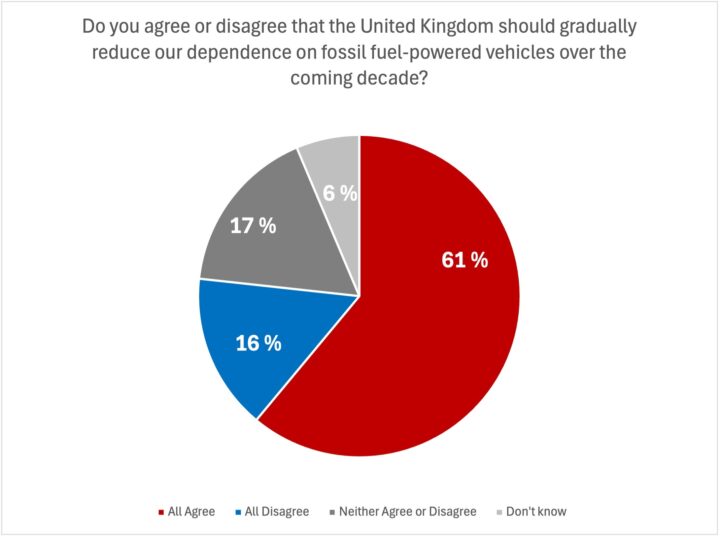
Six in ten British adults (62%) say the Government should be supporting and encouraging the uptake of electric vehicles (EVs), more than twice as many who think not (28%). A similar proportion (61%) say the UK should reduce its dependence on petrol and diesel cars over the next decade [1], according to new polling released today.
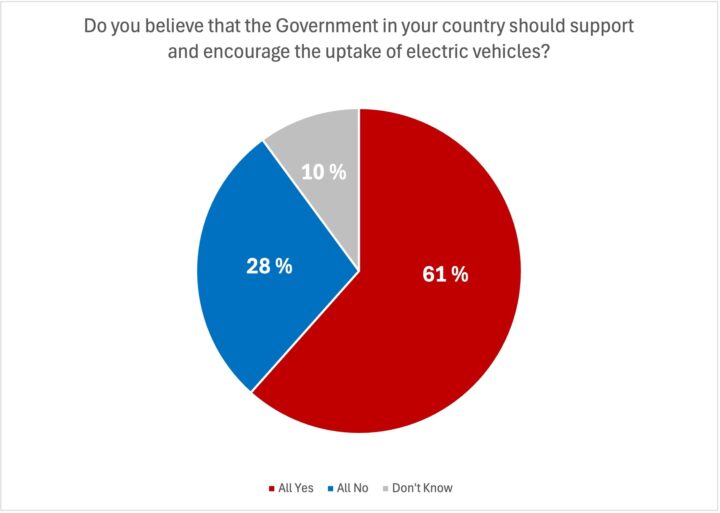
The polling found high levels of support amongst likely Labour voters, who were more likely than any other voting group to say that households with EVs were better protected from energy prices - with 76% of Labour voters agreeing or strongly agreeing that the Government should do more to support and encourage the uptake of EVs. A majority of Green (83%), Liberal Democrat (73%), and Conservative (53%) voters all similarly said that the government should support the uptake of electric vehicles. Amongst likely Reform voters, there was a broadly even split between support and opposition to government measures to increase the uptake of EVs.
The results come as speculation over the future of the UK’s EV sales targets has reached fever pitch – with Ministers reportedly convening last week to discuss the future of the flagship policy, and an apparent split emerging between Whitehall departments on the issue [2].
The Zero Emission Vehicle (ZEV) mandate, which aims to increase uptake of EVs, has been described as the “biggest single policy” to reduce UK emissions [3]. It requires manufacturers to sell a growing proportion of EVs every year, thereby incentivising them to bring their best range of electric cars to the UK market, and driving competition between manufacturers to bring down sticker prices. The industry met its targets for 2024 and 2025, the first two years of the policy, and are on track to meet their 2026 target which is made up of new EV and lower emission vehicle sales [4]. The target is set to eventually rise to 80% of all sales by 2030 [5].
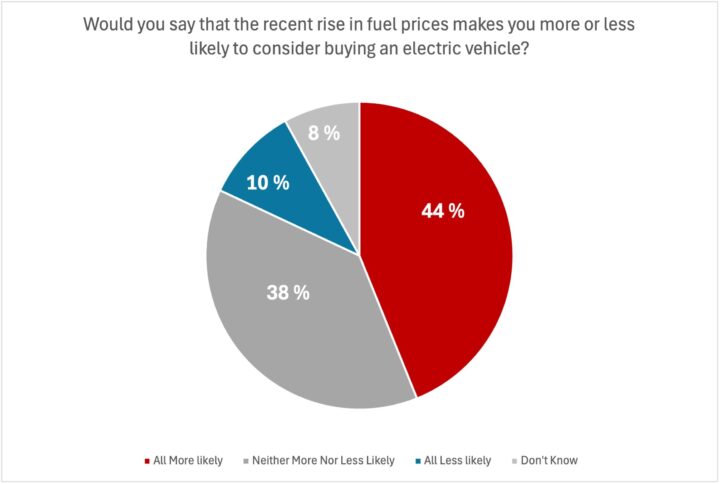
With electric vehicles usually much cheaper to run than petrol or diesel vehicles, EV sales in the UK have continued to rise, as drivers look to shield themselves from the conflict in the Middle East. One third (32%) of all cars sold in October 2026 were fully electric, up by a quarter on 2025 [6]. The polling reflects drivers’ growing concern about their exposure to volatility in international energy markets following the US attacks on Iran, which 72% of respondents said had had a significant impact on their household budgets. Four times as many respondents (44%) said that rising fuel costs had made them more likely to consider buying an electric vehicle than those who said it hadn’t.
However, it is widely reported that some Ministers are now advocating a watering down of the targets, following extensive lobbying by parts of the automotive industry [7]. Analysis by the Energy and Climate Intelligence Unit (ECIU) has found that cutting sales targets for 2030 by just ten percent (from 80% to 70%) could result in nearly one million fewer EVs being sold over the next decade, costing motorists at least a cumulative £3.8 billion pounds in further fuel costs by 2050 [8] and could, together with changes previously made to the policy, result in emissions greater than the burning of all the gas in the Jackdaw gas field [9], which was recently given the green light by the Energy Secretary.
Commenting, Izzy Romilly, Head of Transport at the ECIU, said:
“With the majority of British adults saying that US attacks on Iran have had a major impact on their household budgets, it’s no surprise that growing numbers of drivers are turning to electric vehicles to shield themselves from soaring prices, and that the ZEV mandate is increasingly being recognised as a cost-of-living policy as well as one that comes with public health and climate benefits.
“The government has repeatedly said that it wants to get Britain ‘off the fossil fuel rollercoaster’, but it’s hard to square that aspiration with reports of looming cuts to the ZEV mandate, which could leave millions of Britons driving petrol and diesel cars and paying prices dictated by international markets over which they have no control. The good news for the government is that the current plan is already working: the upfront cost of both new and second-hand EVs is now equal to petrol and diesel cars, making it easier than ever to make the switch to electric, and the automotive sector is on track to meet or exceed its target for a third consecutive year. This is a genuine success story that’s delivering meaningful savings, while also positioning British carmakers to take advantage of soaring demand for EVs in the global markets where the vast majority of UK built cars are sold.”
More than two years after the Lords’ Environment and Climate Change Committee warned that the government was failing to robustly tackle misinformation about EVs [10], the polling also reveals widespread misunderstanding amongst drivers of petrol and diesel cars. Just one in three (35%) drivers of petrol and diesel cars correctly said that households were better protected from ongoing rising energy costs, while almost half (50%) said that they thought EVs were too expensive to buy. This is despite Autotrader reporting earlier this year that new EVs are now cheaper than petrol cars for the first time with EVs having previously reached price parity with petrol and diesel cars on the second-hand market in which the majority of drivers buy their cars [11].
ENDS
Notes to editors:
- Polling conducted by Verian. A representative sample of 1,052 UK adults aged 18 and over was surveyed online between 29 October and 4 November 2026.
- The Times, Labour cabinet split over plans to water down EV sales targets, November 2026
- Green Alliance, Written evidence, 2023
- New AutoMotive, October 2026 UK Sales Data
- Department for Transport, Zero Emission Vehicle Mandate Review, August 2026
- SMMT, Year end push lifts EV sales but mandate gap set to widen, November 2026
- Guardian, UK poised to water down 2030 EV sales targets after industry and union pressure, June 2026
- ECIU, Government slowing UK’s EV sales would cost British drivers billions – analysis, August 2026
- ECIU, Looming EV policy U-turn could result in more than half of Rosebank’s emissions, October 2026
- House of Lords, Environment and Climate Change Committee, EV Strategy: rapid recharge needed (2024)
- Autotrader, New electric cars now cheaper than petrol on average for the first time, April 2026