Ten years post-Paris
The decade that defied predictions
Last updated:
Ten years post-Paris, the direction of travel is clear: the clean energy transition is more advanced than analysts projected a decade ago — and more advanced than many people realise.
The challenge now is to turn that real-economy momentum into a decisive bend in the global emissions curve, while scaling up finance and technology flows — especially for developing economies — and ensuring the benefits are felt by people everywhere.
COP30 in Belém — where all countries are expected to have submitted new emissionscutting nationally determined contributions — offers a pivotal opportunity to consolidate this progress in the face of U.S. opposition. If it can deliver on its goals — reinforcing multilateralism, ratcheting up mitigation ambition, and protecting and investing in nature — it can lay the groundwork for the next great leap in global climate ambition over the coming decade.
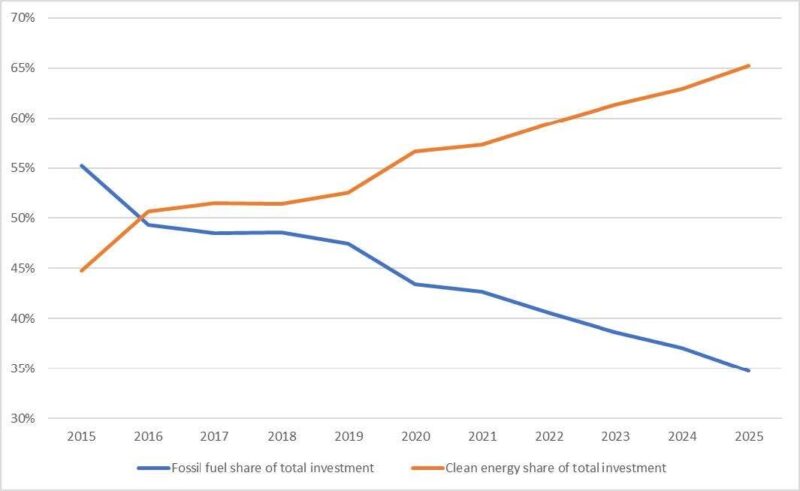
Chart: global investment in fossil fuels and clean energy

| Category | Then/prediction | Now/reality |
|---|---|---|
Renewable energy deployment | IEA predicts 34 GW solar and 40–45 GW wind predicted yearly to 2040 | 673 GW solar and wind installed in 2024 alone - solar was 1,500% above projection |
Cost of solar | “Even by 2035, solar requires carbon price to compete” - BP | Solar is the cheapest electricity in history, down 99.9% since 1975 |
Cost of wind | “Wind energy is the biggest collective economic insanity,” - Nigel Farage, British MP | Onshore wind produces electricity 67% cheaper than fossil fuels. |
Energy investments | Clean energy investment at $232 billion in 2013 | $2.2 trillion investments in clean energy, double fossil investment in 2025 |
EV uptake | IEA predicts 1 in 5 new cars will be electric by 2030. | 1 in 5 new cars are electric by 2024 - 6 years early |
Emissions | Emissions rise 18.4% the decade before Paris Agreement | Emissions increase only 1.2% since the Paris Agreement |
Net zero targets | Zero national net zero laws | 83% of global GDP under net-zero targets |
Climate policy | Small number national climate policies | 19 of 20 G20 countries legally require GHG disclosure |
Jobs | 8.5 million renewable energy jobs in 2015. | 16.2 million renewable energy jobs in 2023 - nearly double. |
Attribution science | Hard to link climate change to specific impacts | Attribution science shows which fossil fuel companies made extreme weather events more likely. |