COP30 – where we landed
A first look at where we got to during COP30, and what landed, just after the gavel fell in Belém

By Gareth Redmond-King
@gredmond76Share
Last updated:
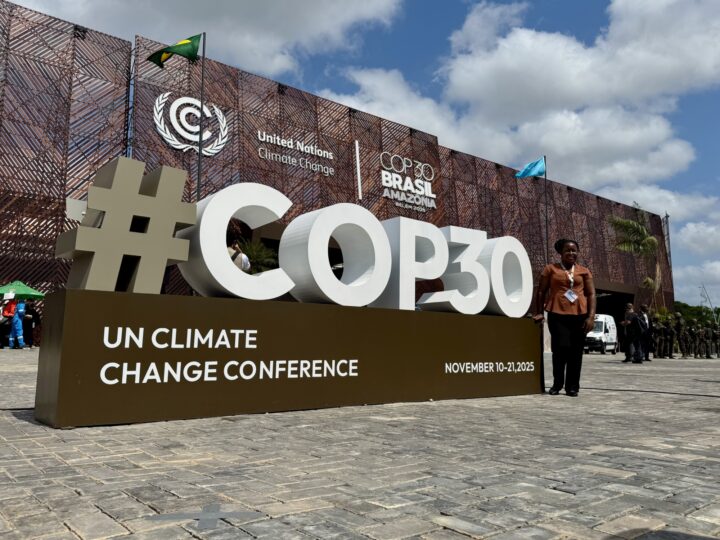
COP30 has just finished. And as we all head home, it is worth starting any look back at where we got to by just acknowledging that, for all the logistical issues, Belém ended up being a very welcoming host city; its people are lovely and could not have been more friendly and helpful. COPs are rarely a joy to attend, but the people in the host city, and especially the volunteers in the venue often make it a lot better than it could be.
The vibes
The leaders’ summit being separate was also an odd start for COP; it normally begins alongside the COP negotiations themselves. There were around 60+ heads of government/state present, though, and well over 150+ nations represented at senior levels. Yet much commentary zeroed in on who was not there – including creating the sense that Chine and India were absent, alongside the US.
Of course the US was absent – and, as Senator Whitehouse, the sole federal level representative from the US present (though not an official US delegate) observed, that was probably on some levels a very good thing, given how disruptive they could have been. But India had a delegation of nearly 90, and China not only was definitely present, but had the second largest delegation, at just short of 800 people, as well as a Vice Premier present at the leaders’ summit. Their achievements were also very present – for those who like to stop at the fact they’re the largest emitter, implying they are doing nothing. They are responsible for a third of the global investment in clean energy, have made a numerical emissions cut pledge for the first time (the experts believe they can over-deliver on threefold), and have seen their emissions falling for much of this year, for the first time.
The substance
COP 30 was one of the sequence of COPs in which there was no one single big thing that had to be landed – like the global stocktake at COP28, for instance. But it was styled from the outset, by the activist and engaged Brazilian presidency, as an implementation COP. And we went into COP30 with a new round of NDCs expected from all parties.

Mutirão
The start of COP often sees attempts to expand the agenda, as parties bring their particular concerns to get them aired, and potentially included in the outcomes and decision text at the end. The presidency – fairly skilfully it seemed – took those items outside the agenda process to create consultations on the gap to 1.5°, finance, ‘unilateral trade measures’ (things like the carbon border adjustment mechanisms being introduced by the EU and UK), and transparency around delivery of pledges.
By the end of week one, these were morphing into a set of discussions the presidency styled as leading to a mutirão declaration; mutirão being an Indigenous term for a collective community effort to pull together to achieve a common task. And as week two started, momentum built around two potentially key outcomes for that mutirão text – a ‘roadmap’ each on transitioning away from fossil fuels, and on delivery of a halt and reversal to deforestation.
Meanwhile, without enumerating the full range of issues being negotiated across the whole of the COP agenda, three other areas were in the spotlight as likely being key to judging the success of COP30.
Adaptation
First was the global goal on adaptation. Although brought into being at COP29, it arrived at COP30 as a largely empty vessel, with little to nothing having been agreed to make it useful for furthering adaptation efforts. A suite of indicators to guide national efforts on adaptation was being negotiated. However, as German climate envoy, Jennifer Morgan observed at one point during the two weeks, there is little point introducing indicators without the means of implementing them – i.e. adaptation finance.
The adaptation finance gap is vast and growing - estimated to be $310-365 billion a year. The promised doubling of adaptation finance at COP26 has not yet been delivered, and trebling it at this COP would only bring that to $120 billion a year - which in turn would be less than half the $300 billion a year in climate finance overall which was pledged last year in Baku. The target of $300m in contributions to the adaptation fund at this COP was missed by more than half.
To state the obvious, this is not charity from rich to poor. Alongside being an investment in stability and security, in the health and wellbeing of people who are increasingly forced to migrate within their country or beyond the avoid climate impacts, it helps support farmers who grow the two-fifths of our food which we import from overseas – a lot of which comes from climate vulnerable nations. Some of the foods most vulnerable to climate change impacts are those whose rising prices are contributing most to food inflation in the UK.
Just transition
Second was just transition. Civil society groups and developing nations were pushing for a mechanism to bring together expertise, tools, knowledge, and other resource of all kinds to assist all nations in managing the transition from fossil fuels to clean energy in a way that doesn’t leave workers and communities behind, as has happened in previous stages of transition – such as the first stages of ending coal production in the UK in the 1980s.
Forests
And third was on forests. The Brazilian presidency successfully launched the Tropical Forests Forever Fund (TFFF) which will leverage private finance from public and MDB finance to generate an income for the protection of climate-critical forests around the world – seeking to make them worth more alive and growing, than chopped down as materials. The fund raised $9.5 billion during COP. But efforts to turn attention to means of implementing and carrying through on various pledges over the years – including those at COP26 – have so far elicited little. There was also expectation that a COP on the edge of the Amazon would not only solve this, but also focus in on the food and agriculture system responsible for vast swathes of deforestation globally.
Where did we get to
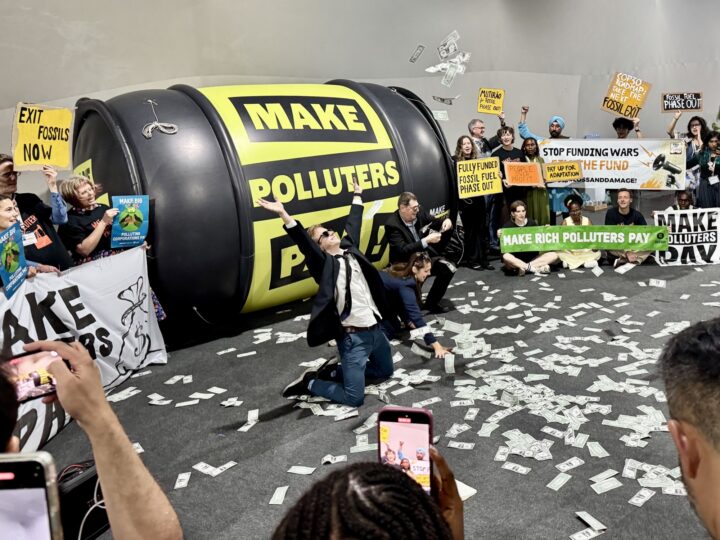
The final outcome delivers, in part. On one level it delivers something formidable – a deal amongst 194 countries at a time when multilateralism is under siege, if not attack. That is no mean feat.
The overall political text adopted goes by the title The Global Mutirão: Uniting Humanity in a global mobilisation against climate change. It was the first text to be adopted. And whilst it doesn’t mention the term ‘fossil fuels’, we do still have what was agreed at COP28 in Dubai, along with an offer from the Brazilian presidency to pursue the fossil fuels roadmap – as well as the one on rainforests – working with, and building on those coalitions which began during this COP fortnight.
On what else has been landed, the just transition mechanism is clearly a successful outcome that is welcomed by civil society and developing nations who pushed for it. Some of the adaptation indicators have been agreed, and the commitment remained to treble adaptation finance – with the added bonus of ‘at least’ being inserted in front.
And there’s a whole load else in the technical detail that, full disclosure, straight off a flight, we’ve not yet had a chance to digest. But others will, and of course the bumper assessment that will come very quickly from our friends at Carbon Brief will be the definitive rundown.
Finally, the Action Agenda is also worth an honourable mention. The Brazilian presidency has resurrected this area, focused around the work of the high level climate champions appointed by COP presidents each year, sub-state actors – like cities, states with nations, companies etc – and originating from COP20 in Lima, just before Paris. It has new lease of life as a focus for implementing promises made already, and this COP has delivered 117 ‘plans to accelerate solutions’. These include on national resilience planning, super pollutants, green industrialisation, clean energy and grids, health systems, tools for farmers to adapt to more sustainable agriculture, and accelerating the doubling of energy efficiency,
Leadership
It’s hard to say where leadership came from at COP30. On fossil fuels, Colombia took a front seat, and the UK played a hard-working behind the scenes role to broker support for the fossil fuels roadmap, emerging with the EU latterly as champions of a fossil fuel roadmap as a red line for them.
But the UK also turned up with no finance – not even anything particularly innovative on leveraging it from private or polluting sectors, given the domestic difficulties of adding public finance right now. They, and other major developed economies spent a long time pushing back on just transition as well, before being persuaded and shifting during week two.
On forests, some 40+ nations were pushing for a roadmap towards the end of the week, with a larger number supportive but not active. On fossil fuels, 80+ were pushing for a roadmap, with around 40 (including the UK) signing up to a Belem Declaration on the subject -pledging action regardless of the COP outcome, including a summit on the subject in the Netherlands next year.
Weird decision
Still up for decision at COP30 was the host for COP31. Australia and Türkiye had been duking it out for the at least a year from within their UN country group, with neither backing down, and Australia swearing blind they would not work jointly on it. The COP32 host was agreed before COP31 (Ethiopia). But late in week two, the two countries announced a joint agreement – one that looks a huge win for Türkiye, who have control of everything, and host in Antalya, whilst Australian climate Minister Chris Bowen acquires what looks like little more than a facilitating gig. And the Pacific Islands, who were to work with an Australian presidency, get to host the pre-COP meeting.
Next time
The biggest gap for further progress, across the board, is finance. The Baku to Belém Roadmap sets out a process for working to the $300 billion a year in climate finance agree at COP29, and then beyond that, to the $1.3 trillion needed by 2035 according to UN-appointed experts. This, with specifically increasing the proportion of adaptation finance, and growing the loss and damage fund, is critical to engagement to reach deals to move further and faster to close the gap to the 1.5°C goal. And it needn’t be that it’s a binary thing of all public money or none; there are innovative proposals that could raise billions globally each year from fossil fuel companies, owners of superyachts and private jets, transactions in the global finance industry (i.e. high finance stuff, not a tax on our every credit card payment) etc. Yet governments with constrained public finances, like the UK, keep swerving these ideas and turning up empty handed. Instead of being the leader it can be, on the basis of its bold plans at home, and consistently strong public opinion – across the country, and in all party political affiliations – that backs action to tackle climate change.
Well, we’ve got a year now, I guess.
Share