UK Steel Strategy expected tomorrow: comment
UK's Steel Strategy launch: comment

By Jess Ralston
info@eciu.netShare
Last updated:
Commenting on the UK Government's Steel Strategy, Jess Ralston, Head of Energy and Industry at the Energy & Climate Intelligence Unit, said:
"The UK's steel industry has been in long-term decline since the 1970s for a range of reasons including growing global competition from the likes of China, which outcompetes us on labour costs. Tata Steel said that Brexit increased its transport and processing costs by 15%. There's been a lot of focus on high industrial energy costs but the UK's energy policy costs are lower than competitors in France and Germany and network costs are similar. It's wholesale costs which are the issue with energy experts and UK Steel among those pointing to the UK’s reliance on gas as the main driver.
“With the Strait of Hormuz effectively closed and iron and steel production in Iran disrupted, steel markets are likely to be volatile. Electric arc furnaces can be used to recycle scrap steel much of which in the UK is currently exported, but could be recycled here.
“The steel sector will be hoping for a strategy that looks forward to increased demand for cleaner steel, particularly given the UK exports lots of steel to the EU which has just brought in a Carbon Border Adjustment Mechanism (CBAM). Industry is calling for improvements to the UK's own CBAM which comes into force next year and could protect British industry from dirtier foreign imports."
Welsh voters believe steelmakers should electrify to protect industry and save jobs [7]
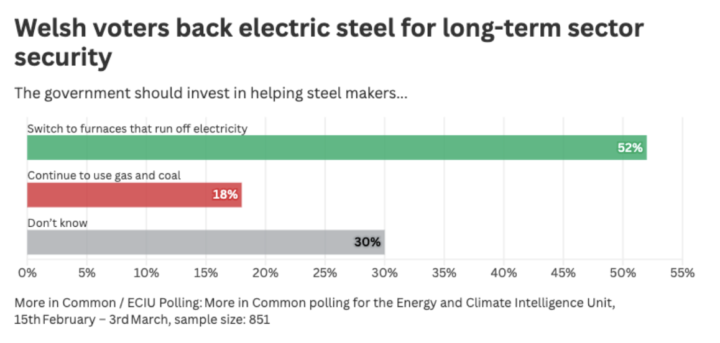
Polling conducted by More in Common on behalf of the Energy and Climate Intelligence Unit (ECIU) has also shown that Welsh voters are more than twice as likely to believe that the Welsh steel industry will be more secure in the long-term if it electrifies its operations than if it continues relying on conventional gas and coal power, as the crisis in the Middle East drives growing concern about the impact of rising energy prices on energy-intensive industries like steel [8].
Over half (52%) of voters said that the steel sector in Wales would be more secure in the long-term if the Government invested in helping steelmaking sites switch to furnaces that run off electricity compared to less than one in five (18%) who said the industry would be better off if the government supported sites in continuing to run on gas and coking coal.
Some opposition politicians have sought to link industrial closures to the UK Government’s policy of achieving net zero emissions by 2050 [5]. However, this is not a view shared by the Welsh public; in the polling the most common causes of steel job losses in Port Talbot and Newport were believed to be competition from China and India (42%), overseas-owned businesses failing to prioritise Welsh jobs (36%) and a lack of support from the UK Government (35%). Just one in five voters (20%) attributed the closures to net zero and climate policies and targets – the second least selected option, after actions by trade unions (9%)
ENDS
Notes to editors:
1. To download the full briefing: https://mcusercontent.com/8ed7ad7972fae058e8f4fb7e8/files/1e2d97ca-55b7-3ef7-5599-b028449c1118/Electric_Arc_Furnace_Briefing.pdf
2. https://www.politico.eu/article/uk-raise-steel-tariffs-to-50-percent-sector-strategy-tata-port-talbot-kyle/
3. https://commonslibrary.parliament.uk/uk-steel-decades-of-decline/
4. https://globalenergymonitor.org/projects/global-iron-and-steel-tracker/summary-tables/
5. https://www.tatasteeluk.com/sites/default/files/pimcore_doc/tata-steel-uk-limited-annual-report-2021.pdf
6. https://www.uksteel.org/steel-news-2024/opportunity-for-gov-to-reduce-power-prices-uplift-uk-steel
7. To download the full polling press release: https://mcusercontent.com/8ed7ad7972fae058e8f4fb7e8/files/9d6cc83a-e92c-bba5-1279-4061f295f0db/Wales_steel_polling_2026.pdf
8. More in Common / ECIU Polling: More in Common polling for the Energy and Climate Intelligence Unit, 15th February – 3rd March, sample size: 851.
9. https://www.reformparty.uk/view-pdf/welsh-manifesto
For more information or for interview requests:
George Smeeton, Head of Communications, ECIU, t: 020 8156 5305, m: 07894 571 153, email: george.smeeton@eciu.net