The 1% fallacy: how collective inaction adds up
Net zero emissions is the only scientifically-backed solution the world has to halt climate change, yet one flawed argument against net zero just refuses to die: ‘but we’re only 1% of emissions’.

By Gareth Redmond-King
@gredmond76Share
Last updated:
Net zero emissions by the middle of this century is the only scientifically-backed solution the world currently has to halt climate change, and limit ever more costly and dangerous impacts into the future. The science is clear, and evidence from our own experience of worsening impacts from rising temperatures - like recent heatwaves - underlines what is at stake.
Yet, like the horror movie zombie you shouldn’t turn your back on, there’s one classic, go-to, off-the-peg argument against net zero that just refuses to die:
... ‘but what’s the point of the UK doing anything – we’re not even 1% of global emissions’ ...
It’s not even a uniquely UK case, as analysis of media elsewhere has shown.
However, it is a zombie we keep having to fight off, time and again.
Scale
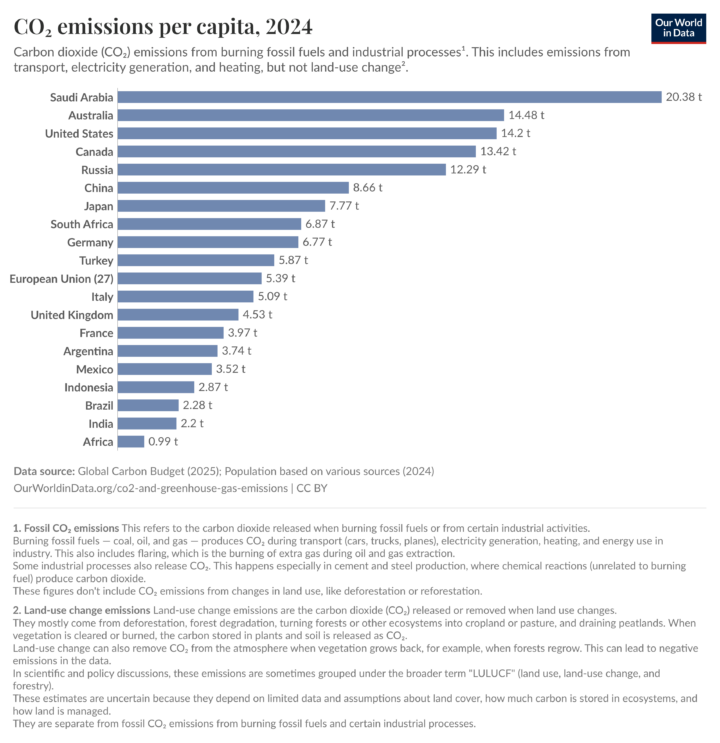
First up, regardless of proportion, we remain one of the biggest emitters globally. Our 2024 CO2 emissions put us at 18th overall amongst emitting countries. For context, the United Nations has 193 members.
If you take the 20 largest economies – the G20 group of nations – and look at CO2 emissions per head of population (or per capita) we were 14th.
That jumps up to 13th if you take out the European Union (given there are several EU member states who are individual G20 members). In sharp contrast, India – the third biggest emitter globally – is at the bottom of that list, at 2.2 tonnes per person, compared to the UK’s 4.53 tonnes per person.
Home and away
The United Kingdom does only account for less than 1% of global territorial emissions. If we take CO2 emissions for 2024 (there are more recent stats for 2025 for the UK, but when you compare globally, you often need to go back a year), the UK accounts for around 0.8% – some 370 million tonnes.
But those aren’t our only emissions; that’s not all we’re responsible for. Our full carbon footprint includes not just emissions we produce at home, but also goods and services we import, which generate emissions elsewhere. This is a more complex calculation, so it takes longer; stats published in June 2026 are for the UK’s 2023 carbon footprint. In 2023, our ‘production’ emissions (those generated within our borders) totalled 385 million tonnes - or 0.71% of the global total of 54.1 billion tonnes that year. Our full carbon footprint, however, was nearly twice that, at 699 million tonnes, or 1.3% of the global total.
We're all in this together
Even if we roll with ‘nah, we’re less than 1%/only 1.4%’, we still need to look around us and see what it means if we opted out. Climate change doesn’t care about borders, and once the emissions are in the atmosphere, they can’t just target the impact they have on the country they came from. This is a cumulative problem that we can only solve collectively.
Yet, we’re not alone in claiming ‘we’re just 1%’. Our recent analysis, looking at media in countries with roughly equivalent emissions, found similar ‘we’re minnows’ arguments in more than 200 articles across national newspapers in no fewer than 27 countries. These countries, home to some 1.85 billion people all told, together accounted for more than 21% of global CO2 emissions in 2024. That is more than the United States at 12.7%, and India (8.3%) combined.
So sure, China, the world’s single biggest emitter, was responsible for more than 30% of 2024’s global emissions. But if all 27 of those ‘around 1%’ countries heeded the op-eds and opted out of action to tackle climate change, over a fifth of the planet’s emissions would be locked in with their inaction.
If we chucked in one or two other nations where such ‘we can’t do it alone, so what’s the point’ arguments can also be found, we very quickly exceed China’s total. Russia and Iran are hardly pioneers of net zero, and Japan is a bit of a laggard; Indonesia takes things more seriously but has a much bigger hill to climb. If we combine their emissions – each responsible for between 2% and 5% – we rack up 32.3% of the global total, overtaking China’s 31.8%.
If we could opt out on the basis of around 1% of emissions, so could all the others. Could we hope to hit net zero without countries responsible for a fifth of emissions? No, almost certainly not.
Our emissions are still up there
Then we get into historic responsibility. The UK was the spark that lit the industrial revolution – which means we essentially invented the burning of oil, coal, and gas to heat, light, make, move and otherwise power stuff. Every single atom making up the greenhouse gases emitted since then went up into the atmosphere. And whilst some of that has been absorbed by nature, which helps keep our climate in balance, most of it is still up there. That means our historic emissions are part of the climate crisis that we face today.
This is why UN climate change processes, and the Paris Agreement, put greater expectation on wealthy developed countries like the UK – not just to cut emissions earlier, but also to provide financial support and assistance to less wealthy, developing countries. It’s because we’ve emitted so much more, and for longer, than most countries in the world.
On CO2 emissions, we remain the fifth biggest emitting country over the period from 1750 to 2024. Even if you chucked in entire continents (Europe, North America, South America, Asia, Oceania, and Africa), the UK is still in eighth place. We’re responsible for 4.33% of all emissions over that period, since we led the way and started burning fossil fuels.
Even on a more sophisticated analysis that factors in the impacts of land-use and forestry, by 2021, the UK was still in the top ten – at eighth place, responsible for around 3% of total cumulative historic emissions.
Leadership
Widening the lens a bit, the UK is influential. Our GDP ranks fifth in the world, we are members of the G7 and the G20, permanent UN Security Council members, and a core member of NATO. We have some standing!
But we’ve also cut our climate-heating emissions by more than half since 1990, with the rate of cut doubling since we introduced the world-leading Climate Change Act in 2008. We have, since Margaret Thatcher was Prime Minister, been at the forefront of world efforts to act on climate change, even hosting the UN climate summit, COP26, in 2021.
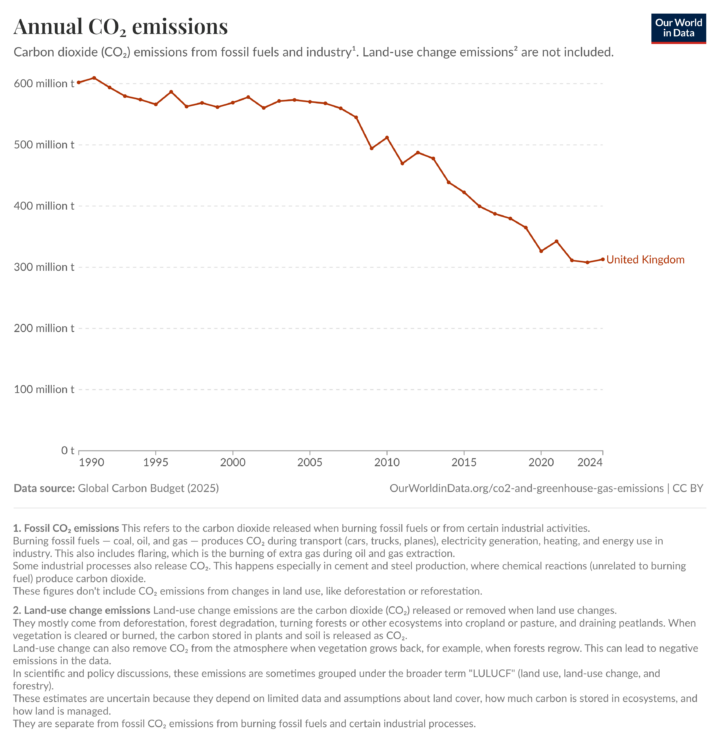
We invested in renewables innovation in the 2010s, becoming the single biggest market for offshore wind for quite some time. In 2019, we became the first major economy to up our emissions target to net zero by mid-century, and in 2026 net-zero industries in the UK contribute more than £100 billion in economic value, providing employment for 1.1 million people.
In other words, not only have we led the way on arguing we should tackle climate change, and showing we can, but also on demonstrating the wider benefits. We have achieved economic benefit at home, and shaped the renewables economy globally, so others can follow. The more - and more rapidly - clean energy tech is deployed, the faster its costs fall; making it faster, easier, and cheaper to deploy more.
Now, we’re operating in a world where the global energy market is worth trillions, with clean energy drawing twice as much investment as fossil fuels. And a world in which a third of our power comes from renewables – overtaking coal for the first time – with clean sources more than meeting growing demand. The UK has had, and still has, a significant role in that.
The alternative – more cost
What the ‘1%-ers’ can’t demonstrate is what the benefit of stepping back from net zero would be.
Quite apart from undermining our competitiveness in global markets that are positively fizzing with investment in renewables, we’re now at a point where more than half our power is generated by renewables, and two thirds of it is clean. Coal-fired power disappeared completely in the UK a couple of years back. More of our power being home-grown means less reliance on imported fossil fuels. Right now, still reliant on gas for a chunk of our power, we have some of the more expensive electricity prices in Europe as gas prices have surged. But if there had been no large-scale wind capacity in the UK, with gas covering the difference, our day-ahead wholesale prices in 2025 could have been up to a half higher again.
The more we replace expensive – and volatile – imported gas with renewables, the more we insulate ourselves against global fossil fuel shocks, such as we have seen for the second time in five years, with war in Iran. And if you want a decent example of that, see Spain – which has some of the lowest power prices in Europe.
The UK’s Climate Change Committee has recently shown that the cost of transitioning to net zero is less than the cost to our economy of a single fossil fuel price shock. (A reminder once again that we’re on our second within five years…) This, at the same time as they warn that worsening climate change “is undermining the UK’s security and prosperity”; a point echoed by the UK’s national security advisers who caution that climate change and biodiversity loss also pose a growing risk to our food security.
Climate change has already played a major role in the cost-of-living crisis, hitting food harvests at home and abroad. In two years (2022, and 2023), climate impacts added around £360 to the average UK household food bill. Food prices have risen more than 40% since mid-2021, outpacing wages which have grown less than 30% on average.
Extremes everywhere – fires, floods, heatwaves, storms – are getting more dangerous and more expensive. 2025 was the third hottest year on record, joining 2023 (second hottest) and 2024 (hottest). 2026 is likely to experience a particularly strong El Niño effect, running into 2027. That will turbo-charge climate change impacts, and likely propel 2027 to the top of the list of hottest years.
If we don’t limit temperature rises – by cutting emissions to net zero – then these harms keep worsening, and the costs keep rising. Inaction on climate change costs us all more than action to halt it.
And we’ve barely mentioned China…
Well, what about China! Their emissions are falling, their oil demand has plateaued, and they’ve committed to an absolute emissions reduction target for the first time.
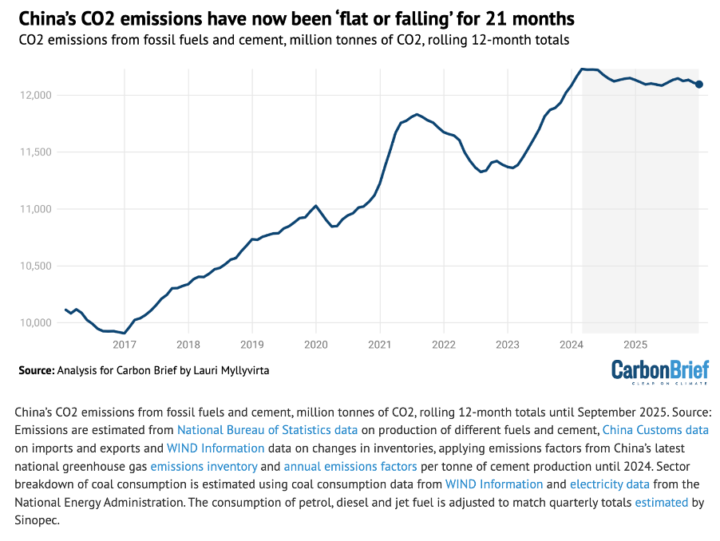
Clean energy made up more than 10% of China’s economy in 2024 and clean energy sectors drove more than a third of China’s GDP growth in 2025 as they manufacture and install more wind and solar than the rest of the world put together, exporting so much of it, that Chinese clean tech exports along may account for a 1% reduction in emissions outside China.
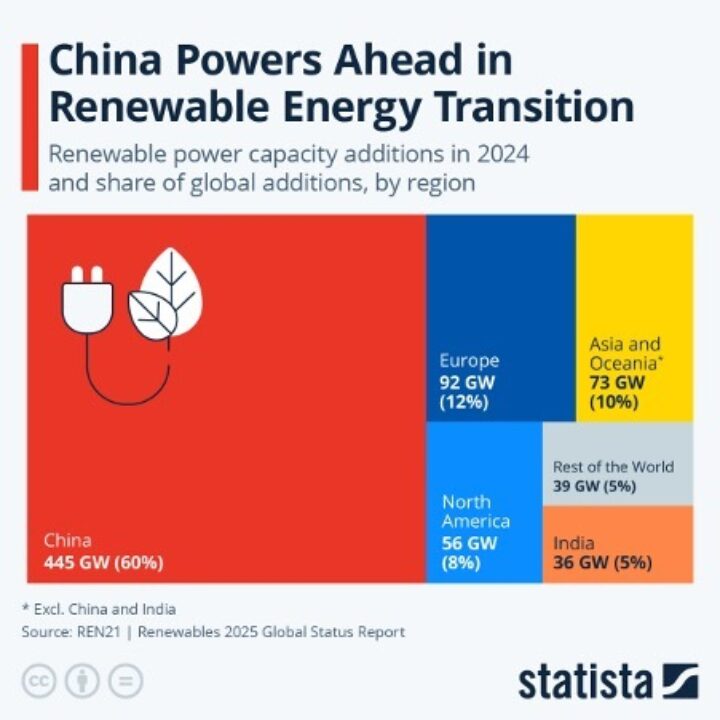
So if you believe the people who tell you that China is doing nothing, then I’ve got a bridge to sell you.
The bottom line
We’re running out of time to limit temperature rises to 1.5°C – or stand a chance of scaling them back, if we overshoot. Every fraction of a degree matters, and the worsening impacts at 1.4°C of heating are hitting us day-to-day. Every country has to play their part, no matter the share, because none of us can opt out of the consequences.
But it’s also more cost-effective, healthier, cheaper, and safer to act now, than not. And if the fifth biggest economy in the world doesn’t want to be part of a global clean energy market valued at $10 trillion, which boasted US$5.5 trillion in revenue last year, then someone else will – and we’ll lose out, in more ways than one.